
The Night Thebes Came to France
- by Isaac Leaver
6th February 1944. Paris.
Exactly four months before the start of the Allied liberation of Western Europe, France was groaning under the weight of nearly four years of foreign occupation. The edicts of Nazi Kommandanturen dictated the course of daily life exhaustively. In the south, the Vichy Regime under the octogenarian Marechal Pétain had been all but completely neutered of whatever shadow of autonomy the 1940 Armistice at Compiegne had promised it. French workers were being shipped forcibly to Germany as part of a compulsory war effort programme—the Service du Travail Obligatoire. French Jews were being shipped forcibly to death camps as part of an even more abhorrent project.
This was neither the sort of time nor place in which one would expect open criticism of the state.
Yet, on this evening, at the Théâtre de l’Atelier in the 18e arrondissement in Paris, the curtains opened on a new play written that provided such just such criticism. Antigone, written by the then young playwright and ex-French prisoner of war Jean Anouilh, revolves around the conflict of what one is expected to do when the laws decreed by a government, although designed to maintain order, contravene one’s moral compass. Does one submit or does one resist, even if resistance means certain death?
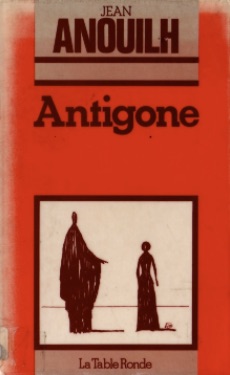
For the theatre-goers, acclimatised to the arguments of collaborators with and sympathisers of the Occupation that at least the Germans brought ‘stability’ after a decade of political turmoil, the parallels their present situation would not have been lost. The autocratic ruler Créon in Antigone, an ageing man who “has wrinkles, is tired, plays the difficult game of managing men” presented some clear similarities with Pétain or even the faltering Nazi order. The eponymous protagonist Antigone—and her defiance of the directives of this ruler that leads to an order for her execution— cut a figure akin to that of a member of Le Maquis irregulars who fought guerrilla campaigns from the hills of the south.
In a state where censorship was enforced with rigour and the very idea of dissent suppressed violently, one must wonder how Anouilh ever managed to get his script approved by the government and avoided the terrifying knock of the Gestapo at his front door.
His genius was that he did not ‘create’ his story. Indeed, the story of Antigone and her wilful stubbornness had been in the cultural mainstream for almost twenty-four centuries. In 441 BC, to fervent crowds in Athens, the same tale had been relayed, in this instance through the hand of one of the three great tragedians of the age, Sophocles. Creon, the unexpected and reluctant new king of Thebes, tries desperately to impose some order on his city after a civil war by commanding that the previously rightful king Eteocles be buried with appropriate rites whilst the carrion of his rebellious brother Polyneices is to be left on the battlefield for the dogs and birds to ravage. Antigone, princess and sister of both Eteocles and Polyneices, perceives this as morally wrong (as do the gods) and so steals away to bury Polyneices’ body. Such is his belief in the law that Creon has no choice to punish Antigone, even as this leads to his unravelling and the suicides of his own son, Haemon, and wife, Eurydice. The king of Thebes is left at the end of the play with his regime intact, but his family gone, a lone pillar of tyranny weeping as he holds his son’s corpse.
Anouilh’s decision to take a classical tale and retain its classical setting was a sure factor in securing the green light from the authorities of Occupied France. For the censorship bureau, this appeared nothing more than a faithful retelling of a classic from Ancient Greece, the wellspring of Western Civilisation whose cultural influence they were keen to impress. However, there were hints that this was to carry an underlying message of resistance. The theological considerations of Sophocles’ original were stripped out, arguably in an effort to give it more ‘civic’ relevance and a moral appeal beyond just that of the theists. Instead, Antigone faces up to a king who bewails his position as the one designated to bring order out of chaos but nonetheless will commit himself to this task even if it means causing bloodshed. How much sympathy can one have? Anouilh appears to ask, from someone who professes to hate being the establishment but continues to be it nonetheless.
This genius to export criticism of the current regime to that of an ‘other’ time and country was in turn itself an Athenian device also. Just over a decade later, whilst the Peloponnesian Wars were raging and Athens was suffering from the devastation of plague, Sophocles wrote a play about Antigone’s father and one-time mythical king of Thebes, the infamous Oedipus. During the course of this play, Oedipus’ nefarious rule as the murderer of his father and husband of his mother incurs the wrath of the gods and prompts them to send a plague to tear through his city. The Athenian audience of 429 BC may well have left their seats following Oedipus Rex wondering if they were facing divine retribution for labouring under the direction of an equally reprehensible government.
The obscure names and fanciful plots of Athenian tragedy can seem all too distant from our reality in the modern world, these plays mere curiosities to be studied (or, to be cynical, mines of recondite references that can make us sound educated). Should anyone doubt their enduring spirit of the works of Aeschylus, Sophocles or Euripides, then they would do well to consider that—even for just a couple of hours—one such ancient text gave the weary and beleaguered audiences of wartime Paris a brief flash of resistance amongst the suffocating censorship of their situation. A brief flash of the possibility of retributive justice against their occupiers and oppressors. A brief flash of hope.
To receive notifications of new blog posts, please follow us.

