
Read More

Comparative Mythology Through Drama
Exploration | Enquiry | Collaboration | Performance | Reflection | Presentation
Winter School and Summer School only
In every place across the globe where humans began to emerge over three-hundred thousand years ago, our ancestors expressed their wonder at the mysteries of existence in imaginative explanations of how and why the universe is how it is.
Our common heritage is the mythology of the world, from Pangu to the titans to the great turtle to floods and fire and beasts and the nature of evil and of fate. Our common heritage is our shared legacy of imaginative out-workings of the inexplicable and of the important.
In these special one-week comparative mythology activities, children will explore our shared human heritage through dramatic interpretation of our ancestors' stories. Students will begin the week with an introduction to mythology in general. Next, they will read and analyse two separate myths on the same topic – one Greek and one Chinese.
“My favourite thing that happened from the week was when we worked on the Chinese myth of Chang'e. My students were vaguely familiar with this myth already - they knew bits and pieces, but they couldn't tell the whole story. However, they were really excited to tell me what they already knew. Then, as we went through the myth together, I saw their eyes light up a lot as the story unfolded and it began to make sense to them.”— Mr Hill
Comparing the myths
All topics will present an element of the shared human experience and aim to provide an understanding of common natural and social happenings. Through analysis, students will compare and contrast the ancient Greek people's understanding with that of the ancient Chinese peoples.
“In the classroom, I was really pleased with the fact that students were able to clearly compare the two myths and critically think and analyse the information they were presented with.”— Ms Rautenbach
From storyboard to script
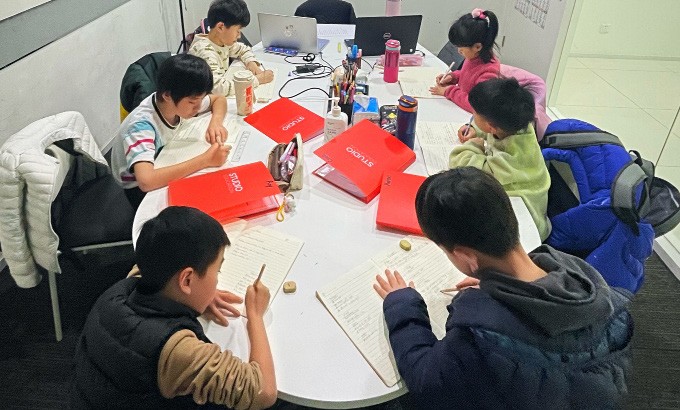
After grappling with, and discerning meaning from both myths, students will collaboratively devise two short playscripts re-enacting the teachings and themes of each myth. Preparing to perform these short playlets will be a significant part of the week's activities. Students will create storyboards, ordering the most significant events in the story. Next, these events will be sorted into logical scenes. Finally, the scriptwriting process will begin.
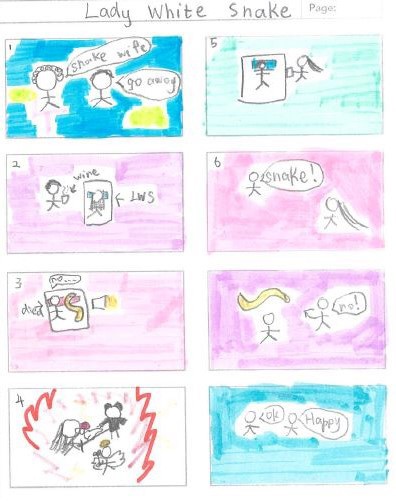
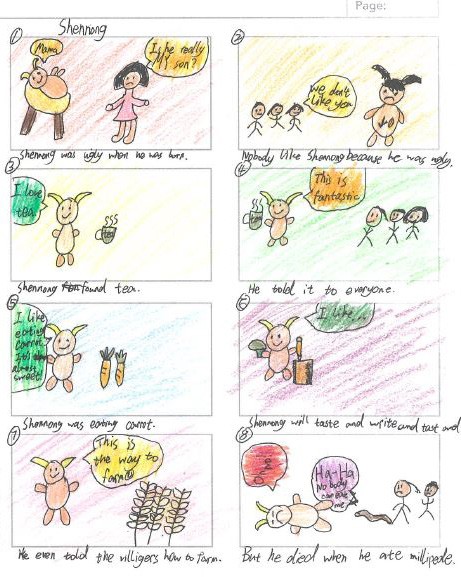
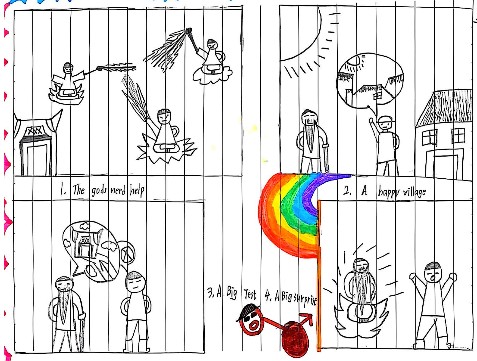
“The myths give us characters who we know some things about. For example, maybe we know their desires, fears or goals. But then students have some freedom to develop the character, through their lines and actions, as they write the playscript. This challenges students to make sure they actually understand the character, but then they can add in some of their own ideas to make it more interesting. I think it's a good balance between structure and creativity.”— Mr Hill, when asked to reflect upon how scriptwriting benefits students
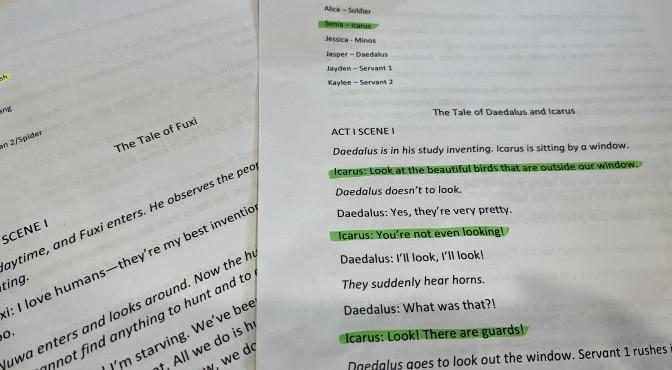
Rehearsal and performance
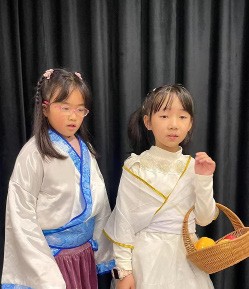
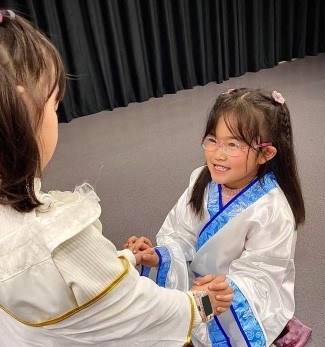
Once the scripts are written, the next step is to rehearse. Students will need to collaborate to present the scenes in a way that will make a meaningful impact on their audience. They'll work together to devise scenes and select costumes and props in preparation for filming their final performance.
“My favourite part of the week was acting in the drama performance because it helped me believe that I was that character. Using drama helped me feel what the main characters, Nvwa and Prometheus, felt, and I think learning about these stories through drama was better than just reading them.”— A KCB student
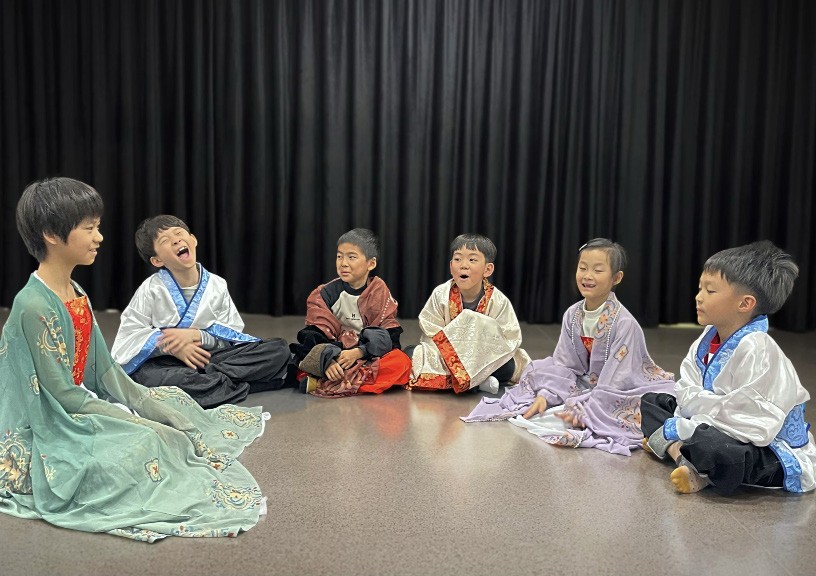
“During the performance, we scurried around the spacious classrooms, playing like a few active dragons stepping on clouds in the sky. Gradually, our mood changed from nervous to relaxed. Sometimes, our performances are funny! For example, when Xu Xian in the script died, the person who played him was lying on the ground like a crooked earthworm, but he still had a funny expression on his face! At that time, the rest of us were stunned for a moment, and then laughed.”— creative writing from a PEF student about her CMD experience
The Enquiry Journal
An important task which appears throughout the whole week is reflection. Students will be asked each day to reflect and record their ideas about the experience in an Enquiry Journal.
“Writing in an Enquiry Journal provides students with a daily opportunity to reflect, imagine and make connections. Unlike typical writing tasks, this one comes with fewer instructions or guidelines – students are simply asked to respond to the day's topics and activities in whatever way feels natural and compelling. Students are encouraged to write down their questions, draw, create charts or Venn diagrams, or just write whatever is on their mind, in any style ranging from free flowing prose, to even poetry or lyrics!”— Ms Beresford
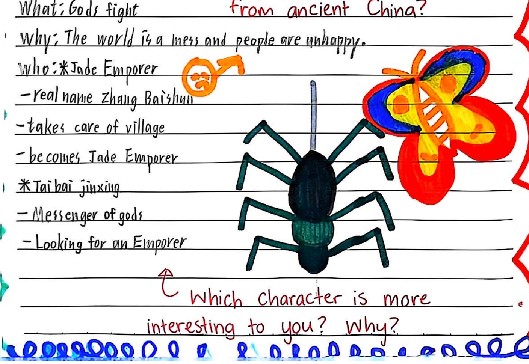
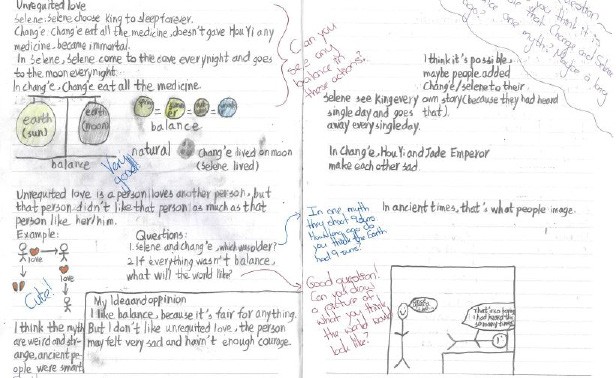
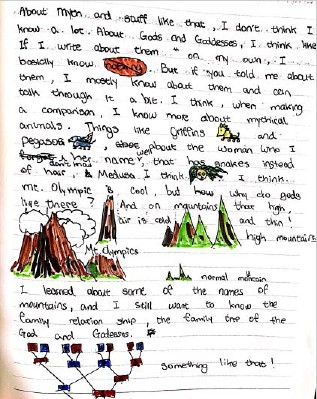
“What I liked most about the enquiry journal is each day I could think about the questions I had. The pictures [I drew] helped me.”— George (student)
“The journals are an opportunity to reflect on what is happening in class as we explore these myths. Because this class is about answering questions and understanding myths, students can also begin asking their own questions, lending to the greater conversation surrounding these myths.”— Ms Greig
The presentation
“The final task of the week will be to prepare and deliver an oral presentation using Enquiry Journal entries as a guide. After spending the first part of the week building confidence onstage, students will be well prepared to speak naturally and freely to their peers about the contents of their journals. The courage required to deliver an oral presentation, the rigour of the week's topics, and the creative freedom this presentation allows will enable students to speak confidently and joyfully, sharing a glimpse into the part of their minds they've cultivated while reflecting in these journals.”— Ms Beresford
A week of wonder
Through a week's worth of activities, Studio Education aims to inspire wonder, encourage exploration and inquiry, and foster creativity through writing, drama and collaboration. For as long as humans have had language, we've had stories. And where stories exist, so do imagination, meaning and possibility.
Much in the same way that our ancestors long ago used myths to create understanding or preserve meaning, Comparative Mythology Through Drama brings these stories to students to give them a chance to make connections and reflect upon our shared human experience. Children will develop a sense of the commonality of humankind, through exploration, collaboration, creativity, performance and reflection.

“I found my child became more confident. She worked very closely with her mates and showed quite good quality teamwork. These things are so valuable and could hardly be acquired from daily school study.”— Parent
The myths, week by week
Each Winter School and Summer School week pairs one Chinese myth with one Greek myth on the same aspect of the shared human experience. Children are arranged according to age: 7–9, 9–11, and 11–13, and according to their Primary English, Kids Canon or Teens Canon level.
Winter School
PEP–PEF — the four weeks
Week 1 — Hearth · Zao Jun / Baucis & Philemon
How does the way we welcome guests reflect upon our character? Of course, people are polite and generous when they are welcoming an esteemed guest, but how would they behave if the visitor was unwanted?
How does a once wicked and selfish man become a respected God of the kitchen, representing luck and sweetness?

Week 2 — Mountains · Lady White Snake / Attack on Mount Olympus
When Gaea becomes furious with Zeus, she brings hideous giants to the world to wage war against the young gods on the peaks of Mount Olympus. Can the giants defeat the young gods?
When Xu Xian receives a warning that his wife is a thousand-year-old snake, he first rejects the claim. But at the Dragon Boat Festival he tries to persuade her to drink realgar wine, known for driving away snakes...

Week 3 — Messengers · Taibai Jinxing / Hermes
Hermes, a cunning young boy, gets into a lot of trouble on his very first day on earth. How will he use his cleverness to negotiate? Will his actions be rewarded or punished?
When Taibai Jinxing, the messenger of heaven, is sent to earth disguised as a beggar to find a new leader, will he find the person he is in search of?

Week 4 — Oceans · The Monkey King / Odysseus is turned away from Ithica
When Odysseus is given a gift from King Aeolus, he proudly attempts to return to Ithica with his treasure. What consequences will this gift and Odysseus's actions have on the kingdom?
When the Monkey King journeys to the Dragon Palace at the bottom of the Eastern Sea in search of a suitable weapon, will he find what he seeks?

KCI–KCA — the four weeks
Week 1 — Thunder · Lei Gong / Phaethon
No one believes that young Phaethon is the son of Helios, so he begs his father to let him drive his chariot, but disaster ensues. How does a thunderbolt teach Phaethon an important lesson about being too prideful?
Lei Gong is tasked with punishing wrongdoers on earth, however he can't see well in the dark and his thunderbolts often miss their intended target. Can his wife help him improve his aim?

Week 2 — Agriculture · Shennong / Demeter and Triptolemus
How does Triptolemus spread his knowledge of the cycles of the earth to the people, allowing them to understand how to plant, sow and reap? Which of Triptolemus' lessons do we still use today?
What will Shennong teach people on earth about farming tools and techniques? How can he use his special abilities to learn about the effects of different plants? What other gifts will his selfless actions bring to humanity?

Week 3 — Hunting · Zhong Kui / Actaeon
Will Actaeon learn the hard way the consequences of angering the gods? Will this experience teach him to think more carefully about his actions in the future?
Zhong Kui is a legendary demon hunter. He is intelligent and loyal, but his unfavourable appearance causes him to be judged poorly and rejected in life...

Week 4 — Family · Butterfly Lovers / Eros and Psyche
When the king is unable to find a suitable match for his stunning daughter, Psyche, he follows the advice of an oracle and sends her off, alone, to await her husband. Will she find the one she seeks? Or will her love story end in tragedy?
When young Yingtai Zhu's parents tell her she cannot go to the academy and study, but instead must wait for the matchmaker to find her a husband, she runs away from home to go anyways.

KCB+ — the four weeks
Week 1 — Supreme Ruler · Jade Emperor Tricks the Monkey King / Zeus
When a child decides to overthrow his father and become the supreme ruler, to what lengths will he go to keep his title? What must be done to a cruel and unjust ruler?
The Monkey King is thrilled with, and excels at, his new position in heaven, until a foolish assistant lets an important secret slip. Will the Monkey King's pride leave him furious and vengeful?

Week 2 — The Underworld · The Heibai Wuchang / Demeter and Persephone
When Hades fell in love with Persephone, he stole her and took her to the underworld. Can her mother Demeter get her back?
A prisoner escaped from the hands of two guards who were escorting him through the wilderness of China. A tragedy happened as the two guards were trying to recapture the prisoner. How did the premature death of one person allow the Jade Emperor to appoint the guards as keepers of the underworld?

Week 3 — Floods · Gun & Dayu / Lycaon and Deucalion
When Zeus descends from Mount Olympus, home of the gods, to see how Lycaon, an immoral king, is governing, he is very displeased. Zeus conspires with Poseidon to teach Lycaon and the mortals of earth a lesson. Who will survive his soggy punishment, and will this event teach them to be more moral?
Emperor Yao is dismayed to see floods ravaging his kingdom and calls upon Gun to help restore order in the land. Will Gun be able to stop the floods and restore order?

Week 4 — Origin of Mankind · Nvwa / Prometheus
When Prometheus meets the Three Fates in a cave they prophesize that his children will inherit the earth. How will this prophecy guide Prometheus to create humans to inhabit and inherit the earth?
When Nvwa stumbles across the earth, brimming with nature and glorious creatures, she can't help but notice the absence of thinking, laughing creatures like herself. How will her loneliness inspire her to create a new kind of life on earth?

Summer School
PEB — the four weeks
Week 1 — Helping Others · The Man with 100 Mothers / Melampus and Bias
Tong Shanren suddenly has too many mothers! He is forced to go against his nature and perform acts of kindness to resolve the situation. Does this change him?
Melampus, for his kindness is given the gift of understanding animals. Imagine which animals you might consult if you could and what you might ask them.

Week 2 — Magic and Potions · Ugly Mrs. Liu / Odysseus and Circe
A woman who desires to be beautiful more than anything. A priest who claims he can change her face with magic. Is this a good idea?
Circe, the immortal goddess and witch, uses magic to prevent Odysseus from leaving her island.
What would you do with magical powers?

Week 3 — Tricks · The Dog that Nipped Lv Dongbin / The Minotaur
Lv Dongbin is one of the famous Eight Daoist Immortals. The most famous saying is that a dog who bites Lv Dongbin doesn't know a good person.
King Minos ruled Athens and forced the Athenians to deliver seven youths and seven maidens every nine years. They became prey of the Minotaur in the labyrinth. The Minotaur was a terrible monster with the body of a man, and the head of a bull.

Week 4 — The Zodiac · The Great Race / Scorpio
Learn how each animal earned its place in the Chinese zodiac. Discover who won the ultimate prize and find out why Cat will never forgive Rat.
The scorpion is ready to attack the hunter Orion so they were placed on opposite sides of the sky, so the two will never appear together.
The placement of constellations in the sky are fixed, aren't they?

PEP–PEF — the four weeks
Week 1 — Astrology · The Cowherd and the Weaver Girl / Heracles and the Nemean Lion
Characters in the Cowherd and the Weaver Girl began life in the sky, came and lived on Earth, then went back into the heavens. Imagine how the twinkling stars and changing skies looked when there was no light pollution. Awe and wonder are great catalysts for creativity and inspiration.
Hera wanted to make life difficult for Hercules. An unforeseen consequence of her plotting caused a lion to die. Hera wanted to make amends and lifted the lion up into the sky… where you can still see him today (if you know where to look).
We are all made from stardust! Come and explore the universe with us!

Week 2 — Gold · Magistrate Zhu and the Golden Rod / The Midas Touch
Gold is not always what we want. When Magistrate Zhu gives a magic rod to his wife, he finds out that not everything should be turned to gold.
King Midas loves gold things. He wishes he could turn everything into gold. His wish is granted… and that's when his troubles begin.
Why are we all attracted to gold? What would be better if it was made of gold and what would be worse?

Week 3 — Dragons · The Dragon and the Pearl / Cadmus and Europa
In a rural province in central China a boy finds a field of grass, which grows back each time he ploughs it. He digs up a pearl and hides it in a sack of rice. When the field dies but the rice sack overflows, he and his mother marvel at their good fortune. But, when the emperor hears about it, the boy hides the pearl by swallowing it – and becomes a dragon.

Week 4 — Penniless Heroes · The Dancing Crane / Heracles and Cerberus
Lv Dongbin was wandering in Yue Yang City. As evening came, he felt tired and hungry, then he went to a wine shop near the outskirt of the town. This wine shop owner's name was Xin Shi, a very patient and kind woman. Dongbin ate and drank as he pleased, and he left without paying. After doing this several more times without reproach, Lv Dongbin leaves the kind owner a delightful surprise as thanks.
The 12 Labours of Hercules tells the tale of the half-god Hercules. His father Zeus was King of the gods. But Zeus's wife Hera was jealous of Heracles and determined to make his life miserable. Given 12 labours to complete, his final labour was to descend into the underworld, and bring back Cerberus, the three-headed dog who guarded the gate to underworld, home of the powerful god, Pluto.

KCI–KCA — the four weeks
Week 1 — Animals as Humans · The Fox Sprite / Phrixus and Helle
Well, this is a strange one! A fox takes over the body of a woman to trick the Emperor. It's ok because the Queen Mother of the West asked her to do it.
Still, I wonder if anyone I know is actually an animal in human form...
Actors sometimes use animal characteristics to craft their characters; a nervous pigeon or a confident lion. Perhaps you could imagine yourself as an animal to help you overcome a challenge... which animal would it be?
King Athamas made some bad decisions and eventually ended up living as a wild animal. What is it to be human?

Week 2 — Tests and Challenges · Three Tests for Fei Jiangfang / Jason Wins the Golden Fleece
Fei Jiangfang was a market inspector from Hu Nan. One day, he saw a lame old man selling medicine in the market. Thus begins an incredible journey for immortality where Fei Jiangfang comes to possess extraordinary magic.
The hero Jason and his crew of Argonauts set out on a quest for the fleece by order of King Pelias. Jason began his journey to find the Golden Fleece and through the help of Medea, the King's witch daughter, he survives and acquires the Golden Fleece.
We all meet with challenges throughout life. But sometimes these challenges are tests in disguise that can lead us to greater heights, as is the case in these two tales.

Week 3 — Oaths and Promises · The Peach Blossom Oath / Helen of Troy
The Peach Blossom Oath was an oath by which the three fighters Liu Bei, Zhang Fei, and Guan Yu became sworn brothers in a ceremony amid peach blossom trees. This act bound the three most crucial men of the future Shu-Han Kingdom of China and is often seen as a true symbol of fraternal loyalty.
Helen was the most beautiful woman from the age of the heroes. Odysseus advised all the suitors take an oath to accept Helen's choice of husband and promise to support that person if she were abducted. She became the wife of Menelaus, king of Sparta. After Helen ran away with Paris, prince of Troy, the Greeks raise armies to fight against Troy and win her back.

Week 4 — Crossing the Sea · The Eight Immortals Cross the Sea / The Clashing Rocks
The Immortals go on a journey to attend the "Conference of the Magical Peach" and on this journey they encounter an ocean. Lv Dongbin suggests that they should use their magical powers to get across. On the way, the Dragon King of the East Sea stops them and both sides begin a furious dispute.
King Pelias sends Jason the rightful heir, on a dangerous quest for the Golden Fleece. Jason and his ship must pass the clashing rocks that close together and smash any ship sailing through. Jason is told by Phineus, a blind prophet, how to fool the rocks. He does as Phineus instructed and successfully passes the rocks.

KCB+ — the four weeks
Week 1 — Heroines · Nvwa Mends the Sky / Otus and Ephialtes
Nvwa is one of the oldest gods. She created humans out of clay and so had a special concern for human beings. Imagine being the first being to meet a human! In this story Nvwa saves her creation from a great flood.
Imagine being the giant sons of Poseidon! It might be very hard not to grow up proud, arrogant and boastful! Luckily, Artemis saves the gods from these two arrogant giants by tricking the two brothers into fighting each other.
There is a perception that most mythical heroes are men. But when we get deeply into mythology then we find that there are lots of female heroes. Where do you think that perception came from? Is it accurate?

Week 2 — Food · How Zhang Guolao Became an Immortal / Tantalus
Zhang Guo began his life as an impoverished peasant youth, helping to support his family. He was often given the task of taking their produce to market, selling it, and returning home with the meager profits. One day, Zhang Guo found a small cauldron filled with a bubbling stew and became immortal.
Tantalus was the rich but wicked king of Sipylus. For attempting to serve a human at a feast with the gods, he was punished by Zeus to forever go thirsty and hungry despite being stood in a pool of water and almost within reach of a fruit tree.
Eating is often seen as one of the pleasures of life. In these myths, sustenance is used to punish as well as to reward.

Week 3 — Duels · Zhang Fei and Ma Chao / Paris and Menelaus
Learn about the fierce, stalemate battle between two of the future Five Tiger Generals of the Shu Han, Zhang Fei and Ma Chao in the Battle of Jiameng Pass.
According to legend, in return for declaring Aphrodite "the fairest," Paris is awarded with Helen of Troy, the wife of Menelaus. After warring to retrieve her, Menelaus challenges Paris to a duel for Helen's return.
Duels are fought about matters of honor. These tales of duels show the lengths taken to restore or gain honor.

Week 4 — Music · Han Xiangzi and the Dragon Princess / The Sirens
Han Xiangzi is nephew of Han Yu, a famous minister and poet from Tang Dynasty. He left his family to learn Taoism, but later he would help his uncle to become immortal too. His talisman is a bamboo flute, and he is a patron for musicians.
Sirens are beautiful women of the sea, who sing songs that hypnotize or lure and trick men into shipwrecking their boats on rocky shores because they follow the irresistible songs. The Siren's song symbolizes temptation, desire, and risk.
Music soothes, entices, and fills with joy. In these myths the power of this medium is displayed and explored.

TCA+ — the four weeks
Week 1 — Brothers · The Royal Uncle Cao Guojiu / Danaus and Aegyptus
When Cao Guojiu discovered that his brother murdered a man in order to steal his wife, he cowardly ordered the woman's execution. Fortunately, the poor widow was miraculously saved by a god and allowed to petition the throne. Cao Guojiu's brother is killed as punishment. After months of repentance, Cao Guojiu renounced all worldly possessions and became a hermit and eventually an immortal.
Danaus had fifty daughters, while his twin brother Aegyptus had fifty sons. The intelligent Aegyptus wanted to get his sons married to the daughters to get the properties of Danaus. Danaus was not willing to surrender his beautiful daughters to his nasty nephews. So he fled with his daughters and thus begins a tale of twisted sibling rivalry.

Week 2 — Filial Piety · Mulan / Euthyphro
Mulan is a legendary folk heroine who shows filial piety by taking her aged father's place in the army, by disguising herself as a man. After a distinguished career, she turns down high office to return to her family.
Socrates and Euthyphro meet at the courthouse. Socrates is a defendant, accused of impiety, while Euthyphro is there to accuse someone else – his own father. This sparks Socrates' curiosity, and he begins to question...
What do we owe our families and how is familial duty determined? In these two stories we witness how two different societies define one's duty to their family.

Week 3 — Nymphs and Fairies · Lv Dongbin and the Peony Fairy / Perseus
Every hundred years, Queen Mother of the West would invite many gods and immortals to her banquet. At this banquet she would give the longevity wine and peach of immortality to all of her guests. When Lv Dongbin does what is forbidden and falls in love with the peony fairy, they are both punished for their crime.
Perseus was the son of Zeus and Danaë. He slayed the Gorgon Medusa. Gorgons were terrible monsters with hair made from writhing, venomous snakes, along with golden wings, boar-like fangs, scaly skin, and long tongues. Medusa was the only Gorgon who was mortal; hence her slayer, Perseus, was able to kill her by cutting off her head.
Nymphs and fairies play a central role in the outcome of these stories. Is their interference a blessing or disaster?

Week 4 — Revenge · Gan Jiang and Mo Ye / The Vengeance of Medea
Gan Jiang and Mo Ye were a legendary swordsmith couple who lived during the Spring and Autumn Period. After displeasing the king, Gan Jiang is killed. His son seeks revenge in a roundabout way.
Medea is set upon revenge against her unfaithful husband. Medea is of divine descent and had the gift of prophecy. She married Jason and used her magic powers and advice to help him find and retrieve the golden fleece. Afterward, Jason divorces her without just cause so she executes terrible vengeance against him.
After putting heart and soul into a task, the characters in these two myths are taken for granted and seek gruesome vengeance on those who've wronged them.

Joining a week
Comparative Mythology Through Drama runs in Winter School and Summer School. Groups are arranged according to age — 7–9, 9–11 and 11–13 — with a maximum of eight children in one group, led by Studio's experienced, dedicated and enthusiastic practitioners in mythology and drama. To enrol your child, please contact your Learning Consultant, or leave us a message.